II 19 Administration

Chapter Contributors
- Rajesh N. Geria, MD, FACEP
- Jonathan Wallace, MD, RDMS
19.1 Introduction
- Administration is a very important part of a quality bedside ultrasound program.
- Much of this chapter is opinion.
Note from the editors: This is not an “evidence-based” topic for the most part. As such, some of this is definition and common sense, but other parts of this discussion are based on the expert opinion and experience of the author, Rajesh Geria. Dr. Geria is a national expert on this topic and the 2012-2013 ACEP Ultrasound Section Chair. That being said, every institution is different, and some aspects may not apply to your specific care environment.
After you receive training in bedside ultrasound, the fun just begins. You must understand and be able to navigate the administrative waters in your institution in order to adequately apply your skills to benefit patient care.
In this chapter we will discuss key concepts that are critical to understand. This will start you on your path to taking your skills to the next level of application within your institution.
19.2 Focused vs Comprehensive
- Focused ultrasound exams are distinct exams that differ from comprehensive ultrasound exams.
- Patients who have focused ultrasound exams performed should be instructed to follow up in very clear terms.
Focused Ultrasound
Focused ultrasound is a goal directed study that seeks to answer a specific clinical question at the point of care. Examples of such clinical questions include the presence or absence of pericardial effusions, pleural effusions, gallstones, intrauterine pregnancy, DVT and abdominal aortic aneurysm. Since these studies are performed at the bedside, physicians can rapidly alter medical management without patients needing to be transported to the radiology suite. This is especially important when patients are ill appearing or unstable.
Comprehensive Ultrasound
A comprehensive ultrasound is a detailed study often done in a radiology suite by an ultrasound technician and later read by a radiologist. It is comprehensive in that it is not looking to answer a specific question with a yes or no answer, but rather it provides a detailed assessment. For example, an ultrasound of the abdomen must provide details of all abdominal anatomy as opposed to just looking for an abdominal aortic aneurysm. An ultrasound of the heart must provide information about valvular function and ejection fraction, not just presence of pericardial effusion or cardiac activity. Some hospitals may not have radiology or echo services 24/7 or may not perform certain exams on weekends, leading to delays in decision-making and disposition.
Example Scenario
All patients who have focused ultrasounds in the acute care setting and are then discharged should be advised to follow up with their primary physician and most should obtain a comprehensive ultrasound. It is imperative that we are clear about the distinction between focused and comprehensive ultrasounds with our patients to avoid any confusion or potential medical liability issues.
For example, a young pregnant woman in her first trimester presents to the emergency department with pelvic pain and vaginal bleeding. You perform a bedside transabdominal ultrasound and identify an intrauterine pregnancy. Assuming there is no suspicion for other etiologies for her symptoms based on history, physical exam and/or lab work, she can be discharged. While performing the ultrasound, the words "normal" or "everything looks good" should never be used. Keeping in mind that this is a focused exam, the appropriate communication should be, "The baby/fetus appears to be in your uterus, it has a heart beat, and there is no free fluid or blood in the pelvis. This is very reassuring to us and great news; however, this is a limited exam so you still need to see your doctor to obtain a follow up comprehensive ultrasound.” Providing clear discharge instructions that explain the general difference between focused and comprehensive ultrasound exams can be very helpful.
19.3 Life Saving vs. Time Saving Applications
- A distinction should be made between life saving and time saving applications.
- These exams should be applied appropriately.
Point of care ultrasound applications are currently divided into life saving and time saving categories Table 16.1. The reason for this division takes into account the struggle that many residency programs were having in teaching all applications due to lack of expertise or infrastructure. After much discussion amongst ultrasound experts and residency leadership, the recommendation was that residency programs should focus on ensuring their residents are competent in the life saving applications upon graduation.
Table 16.1 Division of Applications
| Life Saving | Time Saving |
|---|---|
| Aorta | Gallbladder |
| E-FAST | Renal |
| Cardiac | Soft Tissue |
| Pelvic | Ocular |
| Procedural | DVT |
| Testicular |
This, however, should not undermine the importance of learning the time saving applications, as they can clearly help narrow down a complicated differential diagnosis, improve throughput, and decrease length of stay in the emergency department. Part of the art of mastering point of care ultrasound is knowing when and when not to perform an ultrasound exam, taking into account issues such as patient volume, acuity, staffing and radiology services available.
19.4 Credentialing vs. Certification
- There has always been a great deal of confusion regarding the difference between credentialing and certification.
- Credentialing is a function of your hospital.
- There should be a pathway to bedside ultrasound credentialing at your hospital.
- Certification is a simple record stating that a physician has met the requirements to become credentialed in a specific ultrasound exam.
Credentialing
Credentialing is a function of the hospital where the physician wishes to perform ultrasound exams. In other words, once a physician fulfills the requirements to be considered competent in a particular application(s) as recommend by the ACEP ultrasound section guidelines, a letter is sent to the hospital administration by the ultrasound director and/or chair of the emergency department requesting privileges to perform the exam(s). Once privileges are granted, then the physician is officially credentialed to perform the exam(s) in the clinical setting and must document findings in the medical record. If the hospital does not have an ultrasound credentialing pathway in place, privileges can't be requested and therefore credentialing for point of care ultrasound exams cannot exist.
Hospitals that don’t have a credentialing pathway for emergency ultrasound should have one developed. Per the AMA section 802B document, department chairs can request privileges that allow their physicians to perform ultrasound as long as they follow specialty specific guidelines for training. Ultrasound directors should refer to the ACEP emergency ultrasound guidelines when creating a credentialing document to be submitted to the medical staff for approval. If the hospital denies point of care ultrasound privileges, it is the responsibility of the ED chair to request the reason for denial in writing and formally appeal. Some hospital bylaws are outdated and actually give Radiology control of all imaging performed in the hospital. It is in the ultrasound director's best interest to thoroughly review the hospital bylaws in search of any such clauses prior to submitting the credentialing document to the medical staff for review. Such statements are inappropriate, outdated, and should be removed.
Pathway to Credentialing
Programs have some flexibility when setting up a credentialing pathway. Two common approaches are bundle and application specific credentialing. In the bundle format, a physician is privileged to do any of a group of scans designated in a specific bundle. Examples may be core and non-core bundles. The core may consist of all of the life saving applications. The disadvantage to this method of credentialing is that it does not give any flexibility to the ultrasound director to credential on a rolling basis, which may be needed with physicians who lack ultrasound experience or who graduated from residency programs weak in ultrasound exposure.
For example, at our institution we credential on a rolling basis. So if I feel that an attending is ready to perform FAST, he/she can immediately use it in their medical decision-making while still learning the other applications, rather than waiting until he/she completes the experiential phase of all the applications. Bundle formats may be useful for procedural ultrasound, wherein the experiential phase is vastly different from that of the core applications, as defined by the ACEP emergency ultrasound guidelines. In this case, the physician may only be required to participate in a hands on lab and perform the procedure 1-2 times under supervision and then be credentialed. The physician can become credentialed in all procedural ultrasounds within a one-week period and be checked off on the procedural ultrasound bundle credentials.
Certification
Certification is nothing more than a merit badge stating that a physician has met the requirements to become credentialed in a specific ultrasound exam. It is commonly used in the residency setting when residents meet ultrasound requirements for graduation. In order to apply ultrasound findings to patient care and document findings in the medical record, the attending physician supervising the resident must be credentialed by the hospital to perform the ultrasound.
Upon graduation and meeting the requirements for certification in a set of applications, the ultrasound director should write a detailed letter indicating exactly how many scans were performed in each category as well as how many had pathological findings. This letter can then be used by the ultrasound director and/or chairperson of the emergency department where the resident decides to work in order to request official hospital privileges and credentialing in the desired ultrasound applications.
Hear more from Dr. Geria about getting started in a position as Ultrasound DirectorAudio 19.1.
Audio 19.1 Getting Started
19.5 Critical Documents
- There are many critical documents that you should have and refer to.
There are several essential documents that anyone in a position to start a point of care ultrasound program must be aware of when engaging in discussions with hospital administrators.
AMA HR-230.960 Privileging for Ultrasound Imaging
This acknowledges that ultrasound imaging is within the scope of practice of appropriately trained physicians. It affirms that ultrasound privileges in a hospital setting should be a function of the hospital medical staff. The hospital medical staff should review and approve criteria for granting ultrasound privileges based upon training and educational standards developed by each physician’s respective specialty.
ACEP Emergency Ultrasound Guidelines
This scope of practice document provides a detailed description of training pathways, quality improvement, documentation and credentialing guidelines required to successfully implement a program in emergency ultrasound.
ACEP Emergency Ultrasound Imaging Criteria Compendium
This is a detailed description of indications, limitations, scans protocols, documentation, and equipment specifications of all ultrasound applications listed under scope of practiced defined by ACEP Emergency Ultrasound Guidelines.
Focused Cardiac Ultrasound in the Emergent Setting: A Consensus Statement of the American Society of Echocardiography and American College of Emergency Physicians
This is a consensus statement by the American Society of Echocardiography (ASE) and the American College of Emergency Physicians (ACEP), which delineates the important role of focused cardiac ultrasound (FOCUS) in patient care and treatment and emphasizes the complementary role of FOCUS to that of comprehensive echocardiography. It outlines the clinical applications where FOCUS could be used, as part of the evolving relationship between echocardiography laboratories and emergency departments.
Resident Training in Emergency Ultrasound: Consensus Recommendations from the 2008 Council of Emergency Medicine Residency Directors Conference (CORD)
The goal of this article is to provide a framework for providing US education to EM residents. These guidelines serve as a foundation for the growth of resident education in EM US. The intent of the guidelines is to provide minimum education standards for all EM residency programs to refer to when establishing an EUS training program. The document focuses on US curriculum, US education, and competency assessment.
AIUM Practice Guideline for the Performance of the Focused Assessment With Sonography for Trauma (FAST) Examination
The American Institute of Ultrasound in Medicine (AIUM) is a multidisciplinary association dedicated to advancing the safe and effective use of ultrasound in medicine through professional and public education, research, development of guidelines, and accreditation. This guideline was developed in collaboration with the ACEP Section of Emergency Ultrasound for the purpose of providing assistance to practitioners performing focused assessment with sonography for trauma (FAST) ultrasound examinations.
19.6 Ultrasound Director
- The ultrasound director has many roles.
- How the ultrasound director is compensated for his/her time depends on several factors at the institution.
Ultrasound directors are usually either fellowship trained physicians or existing champions in the department who inherited the role. It is imperative that the ultrasound director has full administrative support prior to accepting this role. Your chairperson must understand the time commitment necessary to build, implement, and run a high quality ultrasound program and be ready to go to bat in order for you to accomplish this goal.
A common question that arises is: “How many hours of protected time should an ultrasound director receive?” The answer may depend on some of the following variables:
- number of years out from residency
- fellowship training
- presence or absence of other ultrasound leaders at your institution
- number of physicians in the group and baseline ultrasound comfort level
- number of sites
Although protected time is important, there are several other items that should be discussed as part of negotiations with the department chair prior to accepting this role. It is not unreasonable to expect more CME than other colleagues in order to uphold credentials, such as RDMS, and pay specialty specific dues (e.g., AIUM). Ultrasound directors should become core faculty and sit on the leadership bench of the department. This usually entitles them to office space, computers and a stipend or increased salary.
Hear more from Dr. Geria about what issues should be taken into consideration before accepting a job as Ultrasound Director Audio 19.2.
Audio 19.2 Ultrasound Director Admin
19.7 Training & Proficiency
- There are two main pathways to become proficient with bedside ultrasound.
- Both of these pathways should be recognized by your institution as valid means to credentialing.
There are two pathways recommended by the ACEP Emergency Ultrasound Guidelines for training, credentialing, and incorporation of ultrasound applications:
Residency Training
- Didactics: Attends regularly scheduled ultrasound lectures at residency conferences or an introductory course.
- Experiential: Training in residency per CORD guidelines.
- Proficiency: Certification letter provided by ultrasound director and/or residency director.
Practicing Physician
- Didactics: Attends introductory emergency ultrasound course.
- Imported - instructors travel to hospital and use department machine.
- Exported - physician travels to remote site and uses machines provided.
- Experiential: Performs ultrasounds under supervision or with over-reads, gold standard confirmatory testing, or patient outcome review within departmental ultrasound plan.
- Scan shifts with ultrasound director.
- Proficiency: Ultrasounds are obtained with documentation and review to meet ACEP emergency ultrasound proficiency guidelines. Ultrasound available for departmental and hospital examination.
In most cases, new residency graduates who can provide detailed ultrasound certification letters from their ultrasound director and/or residency director can request that the medical staff grant them ultrasound privileges upon signing a contract to begin employment. It is up to the ultrasound director at the hospital at which they are seeking employment to support these requests. In some cases, faculty may have graduated several years ago and from a program where ultrasound was not a heavy focus. In these cases, new graduates may need to enter the practicing physician-training pathway and meet expectations prior to qualifying for hospital credentialing.
19.8 Documentation
- Documentation should include: indications, technique, findings and interpretation, whether a radiology-performed study was obtained and how the images were archived.
- Using a reporting template makes the process easier.
- Incidental findings should be communicated with the patient and follow-up provider.
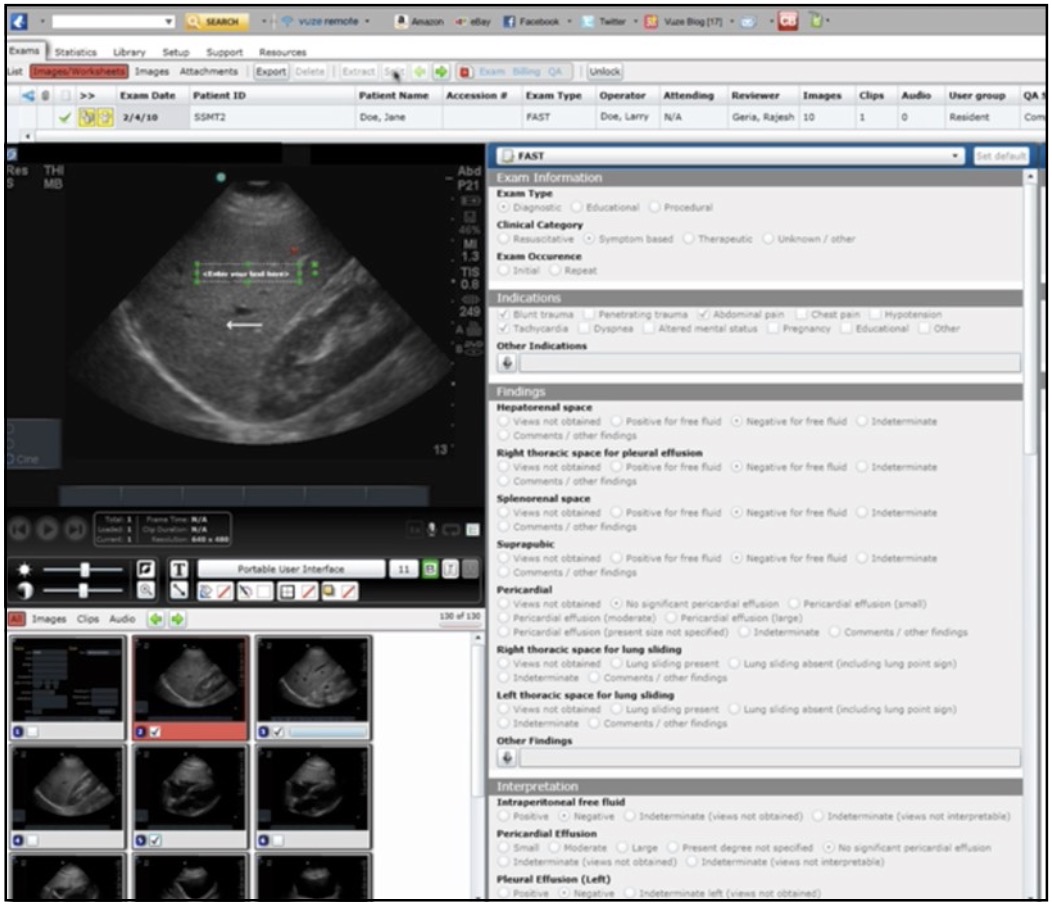
All documentation should include indications, technique, findings and interpretation. In addition, there should be mention of whether a radiology-performed study was obtained and how the images were archived (video, print, etc.). Several electronic medical record vendors have templates for ultrasound reporting, which may make this process easier. The ACEP Emergency Ultrasound section is actively working with vendors to develop standard reporting software to maintain consistency amongst programs. Incidental findings should be communicated with the patient and follow-up provider. I recommend creating an incidental finding form that can be filled out and placed or scanned into the medial record. Formal documentation should result in appropriate reimbursement for services provided.
Image 19.1 Documentation Sample
19.9 Quality Assurance Process
- Quality assurance (QA) is critical to the success of a bedside ultrasound program.
- This should be done electronically, if at all possible, for security and permanency.
- Products exist to greatly enhance this process.
Quality Assurance
A well-developed and maintained quality assurance program is critical to the success of any point of care ultrasound program. Storage of images is a very important step. Although some departments still archive via thermal prints, they are short lived and are not ideal. In an era where the US government is pushing hospitals to demonstrate meaningful use of technology, everything is going to need to be part of the electronic health record. Documenting patient information and scan interpretations on written log sheets floating around the emergency department leads to an inefficient process loaded with issues such as: HIPPA compliance, increased burden on administrative assistants, difficulty tracking data, and lack of a timely process for feedback.
Hear more from Dr. Geria on the topic of quality assurance Audio 19.3.
Audio 19.3 Quality Assurance
In the last few years, there has been an explosion of middleware workflow solutions that enable departments to wirelessly archive images at the bedside via cloud or in-house servers. Physicians can enter scan interpretation by filling out customized worksheets on any computer in the ED with web access or on the ultrasound machines themselves. These images can be submitted for quality assurance review. An email feedback loop is created in a timely fashion and is inclusive of HIPPA compliant image PDF embedding with commentary and even voice over from the ultrasound director. Scans can easily be tracked and sorted for credentialing, teaching, and research purposes. This essentially creates a very transparent and streamlined workflow solution for the department and is revolutionizing quality assurance. Several middleware solutions exist with just slight variations in what is offered.
For more information about workflow solutions, see #Movie 19.1.
Movie 19.1
19.10 Summary
To summarize, the administrative aspect of bedside ultrasound is very important. It is critical to understand these various components to maximize the quality of your bedside ultrasound program.